Solvent Extraction for Industrial Sesame Oil Production: Process Principles and Yield Optimization
2026-03-27
Tutorial Guide
This article provides a technical, decision-oriented overview of solvent extraction in industrial sesame oil production, explaining the underlying mass-transfer principles, typical process flow, key equipment modules, and operational control points that determine extraction efficiency and product quality. It highlights why solvent extraction often outperforms cold pressing and hot pressing in overall oil yield, throughput stability, and energy utilization at scale, while clarifying practical measures to improve yield (pre-treatment, particle size control, moisture/temperature windows, solvent-to-solid ratio, counter-current staging, desolventizing and recovery efficiency). To support safe and compliant operations, the article summarizes mainstream methods for monitoring and controlling solvent residues, and outlines environmental and safety considerations aligned with widely adopted international management practices and food safety expectations. Written for production managers, process engineers, and equipment procurement teams, it focuses on actionable optimization ideas and risk controls relevant to large-scale industrialization—supporting data-driven upgrades in extraction performance and responsible manufacturing for modern edible oil plants.
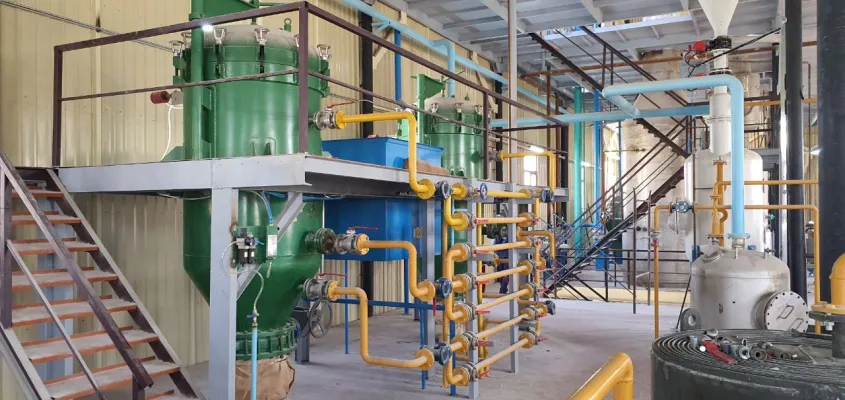
Solvent Extraction in Industrial Sesame Oil: How It Works, Why Yield Improves, and What to Control
In industrial sesame oil production, solvent extraction is often chosen when the business goal is simple: recover more oil per ton of seed while maintaining stable throughput and predictable utilities. For plant managers and process engineers, the value is not only higher yield, but also tighter process control, easier mass-balance verification, and clearer compliance pathways for solvent residues and environmental permits.
Typical extraction performance (reference)
Residual oil in meal after optimized solvent extraction: 0.6–1.2% (w/w), compared with many mechanical-only lines: 5–8%.
Decision metric
For high-oil seeds, each additional 1% oil recovered can translate into significant annual gain at scale—often a stronger lever than small savings in utilities.
1) Process Principle: Why Solvent Extraction Recovers More Oil
Solvent extraction is a mass-transfer process: a food-grade hydrocarbon solvent (commonly hexane in many regions) selectively dissolves triglycerides from prepared sesame material. The driving force is the concentration gradient between oil in the solid matrix and oil in the solvent phase (miscella). In practice, extraction efficiency depends less on “stronger solvent” and more on contact surface area, diffusion distance, residence time, and temperature control.
Core mass-transfer levers (engineering view)
- Preparation quality: flake thickness and porosity determine diffusion length.
- Counter-current contact: fresh solvent meets the lowest-oil solids, maximizing gradient.
- Temperature window: typically optimized for viscosity reduction and safe operation, not “as hot as possible”.
- Solvent-to-solid ratio (S/S): tuned to hit residual oil targets without overloading evaporation duty.
Reference ranges are plant-specific; engineers should validate via trial runs plus mass-balance reconciliation.
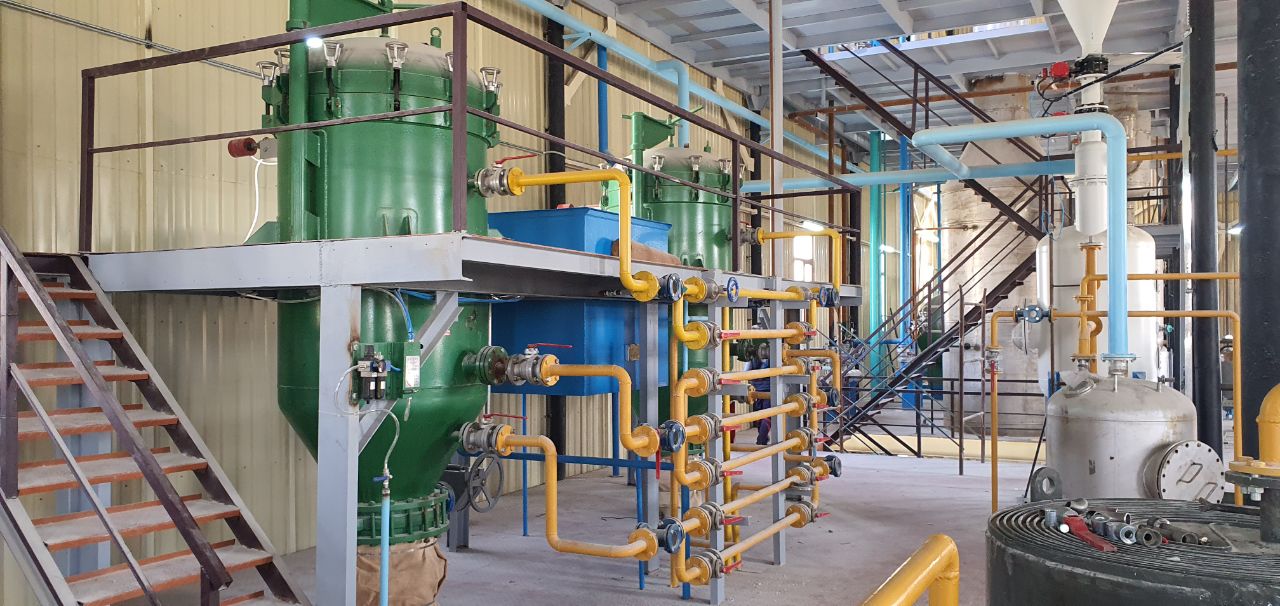
2) Typical Industrial Flow and Main Equipment Blocks
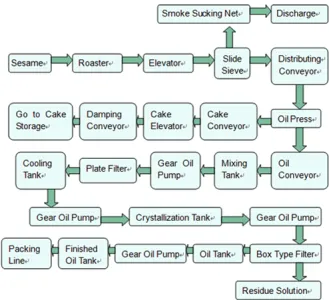
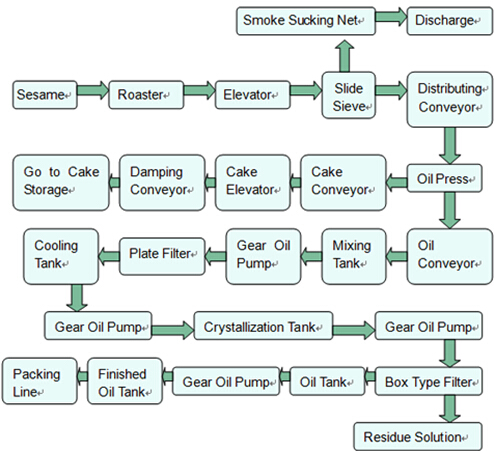
A modern industrial line is usually designed as a closed loop: extraction produces miscella (oil + solvent), then the solvent is separated and recovered for reuse. The equipment set is selected based on capacity, safety classification, and the targeted residual solvent level in oil and meal.
Process blocks (high-level)
| Block |
Purpose |
Critical controls |
| Seed prep |
Cleaning, conditioning, flaking/cooking (as required) |
Moisture balance, flake thickness uniformity |
| Extractor |
Counter-current washing to form miscella |
S/S ratio, bed depth, residence time, leak-tightness |
| Desolventizing (meal) |
Strip solvent from extracted meal |
Steam/vacuum profile, discharge solvent spec |
| Evaporation & stripping (oil) |
Recover solvent from miscella to obtain crude oil |
Final solvent-in-oil target, vacuum stability |
| Solvent recovery |
Condense and recycle solvent, manage vents |
VOC control, condensation efficiency, explosion protection |
3) Yield vs. Cold/Hot Pressing: What the Data Usually Shows
Mechanical pressing remains attractive for “simple lines” and certain product-positioning needs, but from an industrial efficiency standpoint, it commonly leaves more oil trapped in press cake. Solvent extraction is designed to push residual oil down to a tighter specification—especially valuable when sesame seed prices fluctuate and plants need protection on gross margin.
Reference comparison (typical ranges)
| Method |
Residual oil in meal/cake |
Throughput stability |
Energy profile (where it shifts) |
| Cold press |
Often 7–12% |
Sensitive to seed condition |
Lower thermal duty, higher mechanical load |
| Hot press |
Often 5–9% |
Moderate stability |
More thermal input during conditioning |
| Solvent extraction |
Often 0.6–1.2% |
High (with tight sealing & controls) |
Shifts to evaporation/stripping & solvent recovery |
These are engineering reference ranges used for screening decisions; actual results depend on seed oil content, prep, extractor design, and operating discipline.
4) Practical Techniques to Improve Oil Yield (Without Chasing Risk)
Yield improvement in solvent extraction is rarely a single “magic parameter.” The best plants treat it as a controlled system: reduce internal bottlenecks, stabilize feed, then tighten specifications step-by-step. The techniques below are widely used in industrial oilseed operations and transfer well to sesame.
4.1 Optimize preparation: flake thickness and moisture discipline
Preparation governs diffusion distance. As a reference, many industrial lines target uniform thin flakes (often in the sub-millimeter range) with controlled moisture to prevent bed compaction or channeling. Plants that tighten incoming seed screening and conditioning often see 0.2–0.5% absolute reduction in residual oil (meal basis) after stabilization.
4.2 Run true counter-current and measure it like a KPI
Counter-current contact is the yield engine. If valve positions, pump curves, or internals drift, the extractor can “look normal” while losing recovery. Best practice is to track miscella concentration profile at several points and reconcile with a daily oil balance. When the profile is flat, it often signals short-circuiting, bed cracking, or uneven distribution.
4.3 Avoid over-dilution: tune solvent rate with evaporation limits in mind
More solvent can reduce residual oil, but it also increases downstream evaporation and condenser duty. A practical approach is to set a residual-oil target (e.g., ≤1.0%) and adjust solvent rate until the marginal gain is smaller than the marginal energy and capacity penalty. The “best” point is commonly where vacuum stability and evaporator approach temperatures remain steady during load changes.
4.4 Seal integrity and air ingress control (the quiet yield killer)
Air ingress increases oxidation risk and destabilizes vacuum sections, often forcing operators to “open up” stripping conditions—raising solvent losses. Routine checks on extractor seals, manways, rotary valves, and gasket surfaces can reduce solvent loss and improve stable recovery. Many plants treat solvent loss (kg/ton) as a weekly management metric.
5) Solvent Residue Control: Testing Methods and Targets Buyers Ask For
Industrial buyers increasingly request residue documentation—not only for edible oil compliance but also for internal risk management. While specific legal limits vary by market, plants typically manage solvent residues by combining validated stripping parameters with routine analytical verification.
Common verification approach (industry practice)
- Method: Headspace GC or GC-FID for hexane-type hydrocarbons (oil and meal).
- Process checks: monitor stripper vacuum, steam flow, outlet temperature, and condenser performance.
- Documentation: COA + trend charts (residue vs. operating conditions) to support audits.
For regulatory alignment, many companies reference internationally recognized frameworks such as the Codex Alimentarius guidance and apply HACCP-based controls. In the EU context, operators typically cross-check against relevant MRL and solvent-related provisions applicable to edible oils and extraction processing aids.
Plants should confirm applicable limits with local legislation and customer specs; residue requirements can differ by destination country and downstream use.
6) Environmental & Safety Compliance: What Auditors Typically Focus On
Because most extraction solvents are volatile and flammable, compliance is both a legal requirement and an operational necessity. Auditors and insurance teams often look for: closed-loop recovery, documented hazardous area classification, preventive maintenance records, and VOC control performance.
Safety design checkpoints
- Explosion protection (e.g., ATEX-aligned concepts in applicable markets)
- LEL monitoring and interlocks in critical zones
- Inerting/vent management where required
- Operator training + permit-to-work for hot work
Environmental compliance levers
- High-efficiency condensation and secondary recovery
- Controlled venting / VOC treatment strategy
- Solvent loss tracking (kg solvent per ton of seed)
- Wastewater and odor control integration with utilities
7) FAQ (Operations & Procurement)
Is solvent extraction suitable for food-grade sesame oil?
It can be, when the plant is designed for edible oil processing and the line runs validated desolventizing/stripping steps with routine residue verification (commonly via GC methods), plus HACCP-based controls and destination-market compliance review.
What is the most common reason yield underperforms after commissioning?
In many cases it is not the extractor “capacity,” but preparation inconsistency (flakes too thick or non-uniform), channeling in the bed, or counter-current deviations caused by distribution hardware, valve settings, or maintenance drift. Daily mass-balance checks usually reveal the pattern quickly.
How do teams balance higher recovery with solvent loss and VOC risk?
By treating solvent loss as a hard KPI, keeping vacuum sections stable, maintaining seal integrity, and tuning solvent rate to the point where additional dilution no longer delivers meaningful residual-oil improvement relative to evaporation and recovery constraints.
What documentation do industrial buyers typically expect?
A process flow description, safety design basis (hazardous area approach where relevant), residue test method and trend data, solvent recovery performance indicators, and maintenance/inspection records for critical equipment and interlocks.
Where Penguin Group Fits: Engineering-First Extraction for Industrial Sesame Oil
For producers scaling up sesame oil, the practical question is not whether solvent extraction can deliver high recovery—it usually can—but whether the line can deliver it repeatably under audit pressure, seasonal seed variation, and energy constraints. Penguin Group focuses on industrial extraction systems designed around controllable mass transfer, stable vacuum/condensation performance, and compliance-ready operating logic.
Upgrade Your Output, Not Your Risk Profile
Explore an industrial sesame oil solvent extraction equipment solution built for yield, solvent recovery efficiency, and audit-friendly control points—engineered for long-run stability and cross-market compliance needs.