Industrial Sesame Oil Press Capacity Matching for Large-Scale Food Processing: Batch vs Continuous Systems
2026-04-13
QI ' E Group
Industry Research
Is your industrial sesame oil pressing equipment truly matched to large-scale food processing demands? This decision-focused research article gives you a practical framework to evaluate capacity-fit and avoid bottlenecks, overinvestment, and quality swings during line expansion or new plant builds. You’ll compare traditional batch pressing and modern continuous press systems across five engineering-critical dimensions: throughput matching to upstream/downstream rhythm, automation level and labor stability, energy efficiency by unit output, sanitation and maintenance practicality (including cleaning downtime), and food-safety compliance readiness (e.g., 304 stainless steel, FDA-aligned contact materials). The guide connects raw material variability (moisture and oil content) to finished-oil targets (acid value, color, impurity control), and ends with an actionable equipment-selection checklist featuring quantifiable indicators such as daily capacity range, CIP cleaning time, and annualized failure rate—plus a real industry lesson where mismatched capacity reduced yield after expansion and how the issue was corrected. For procurement leaders and process engineers at scale, this helps you build a stable, efficient sesame oil production line with fewer surprises. Get the “Industrial Sesame Oil Equipment Selection Practical Handbook” (PDF) or book a 1-on-1 technical consultation with a Penguin Group engineer.
Industrial Sesame Oil Press Capacity Matching: What Makes or Breaks Large-Scale Food Processing
If you are scaling sesame oil production (or building a new line), “bigger press” is rarely the right answer. The real question is capacity matching: how well your industrial sesame oil pressing equipment synchronizes with upstream pretreatment and downstream filtration, storage, and packaging—without creating bottlenecks, quality swings, or hidden waste.
This decision guide walks you through five practical evaluation dimensions—throughput fit, automation, energy efficiency, cleanability, and food-safety compliance—and shows where batch (intermittent) vs continuous pressing systems typically win or fail in real factories.
1) Market Reality: Why Demand Is Shifting Toward High-Consistency Extraction
Across sauces, seasonings, ready-to-eat foods, and snack manufacturing, sesame oil is no longer a “small-batch specialty ingredient.” Procurement teams now demand stable sensory profiles (aroma, color) and QA teams demand traceability and repeatable specs. That’s why modern industrial sesame oil pressing equipment is increasingly judged like any other critical food-processing asset: by OEE stability, sanitation design, and compliance readiness.
In many plants, the expansion trigger is not only volume. It’s the need to reduce operator dependency and to prevent “micro-variations” from turning into macro losses across thousands of liters.
2) The 5-Dimension Evaluation Framework (Built for Purchasing + Engineering)
A. Capacity Matching: “Rated Output” vs “Line Rhythm”
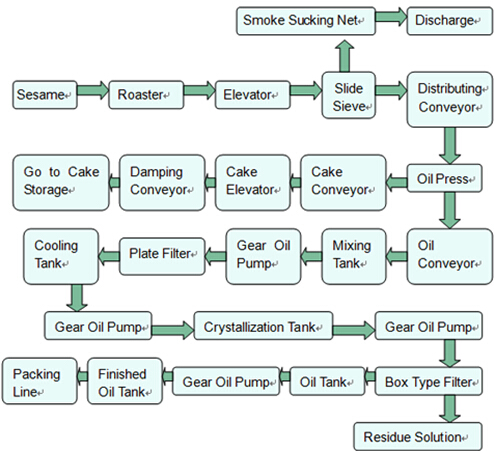
Capacity matching means your press output aligns with the slowest and most sensitive steps of your full process—typically roasting/conditioning, oil clarification/filtration, and packaging rhythm. A press rated at 1.0 ton/hour can still underperform if sesame moisture fluctuates or if filtration becomes the hidden bottleneck.
Practical benchmark: For stable factory operation, many food plants target a buffer so that the press runs at 70–85% of rated capacity during normal production. Running near 95–100% continuously often amplifies stoppages, temperature drift, and maintenance frequency.
B. Automation Level: Labor Cost, Repeatability, and “Human Variance”
In batch pressing, consistency often lives in the operator’s hands—feed rate feel, temperature judgment, filter handling. In continuous systems, stability shifts to controls: sensors, PLC logic, controlled feeding, and controlled discharge.
If your objective is to supply multiple SKUs or multiple plants with consistent sesame oil specs, prioritize equipment that supports standard recipes, alarm-driven correction, and data logging (for internal audits and customer QA questionnaires).
C. Energy Efficiency: Compare kWh per Ton, Not Just Motor Power
Motor nameplate power is a weak indicator. What matters is unit energy consumption and how stable it stays when seed quality changes. In many industrial oil extraction lines, a reasonable planning range for sesame pressing systems (pressing + essential auxiliaries) is around 45–80 kWh per metric ton of seed, depending on process design, pretreatment, and target oil yield.
Energy performance ties directly to capacity matching: when filtration or feeding is unstable, you get more start/stop cycles, temperature drift, and wasted heating—your kWh/ton rises even though the equipment is “working.”
D. Cleaning & Maintenance: The Quiet Driver of OEE
In food plants, sanitation time is production time. You want a design that reduces oil residue traps, supports quick disassembly where needed, and avoids “hard-to-reach” dead corners. If your operation requires frequent product changeovers or strict allergen control, prioritize systems that support CIP-ready interfaces or fast, repeatable manual cleaning routines.
Planning reference: In many plants, a well-designed line targets 60–120 minutes for a standard cleaning cycle, while poor accessibility can push it to 3–5 hours, especially when filters, piping, and oil tanks are involved.
E. Food Safety & Compliance: Materials and Documentation Readiness
Large-scale buyers and auditors increasingly request proof of hygienic design and material suitability. For industrial sesame oil processing, check for 304/316 stainless steel contact surfaces where applicable, food-grade seals, and documentation support aligned with your market expectations (commonly referencing FDA food-contact principles or equivalent local standards; and EU buyers may request documentation aligned with EC 1935/2004 expectations for food contact materials).
3) Batch vs Continuous Pressing: Where Each One Fits (and Where It Doesn’t)
Decision Factor
Traditional Batch (Intermittent)
Modern Continuous Pressing System
Capacity matching
Easier to start small, harder to scale without adding labor and parallel units
Best for stable, predictable throughput and synchronized downstream filtration
Consistency
Higher operator dependence; variability across shifts
Higher repeatability with controlled feeding, temperature, and discharge
Automation & traceability
Limited data logging unless retrofitted
PLC + sensors enable alarms, recipe control, and audit-friendly records
Energy behavior
Start/stop and heat loss can inflate kWh/ton
Typically steadier kWh/ton when line flow is stable
Cleaning reality
Can be straightforward per unit, but scales poorly with more units
Better for standard routines; must verify CIP access and dead-zone design
4) From Seed to Spec: A Practical Adaptation Logic You Can Use
When you evaluate sesame oil production equipment, don’t start with the press model—start with your raw material variability and your finished-oil specification. A press that looks perfect on paper can still create quality instability if your upstream conditioning is not designed for your sesame profile.
Raw Material Inputs to Lock Down
Moisture: many plants aim for a controlled band (often ~4–7%, depending on process); drifting moisture can swing yield and press stability.
Oil content: common commercial sesame ranges can sit around 45–55%; your expected yield must be calculated against real incoming lots.
Foreign matter: higher impurity increases wear, stoppages, and filtration load.
Roast/conditioning profile: impacts aroma and viscosity, which affects filtration and settling behavior.
Finished Oil Targets You Should Tie to Equipment Design
Acid value / FFA trend: reflects raw material freshness and process temperature control; your QA will track drift over time.
Color and aroma consistency: depends on roast control and residence time, not just the press.
Impurities and clarity: tightly linked to filtration capacity and stable feed flow.
Metal control: plan magnets/metal detection and verify wear points in screw/pressing chamber.
“When a plant complains about ‘press instability,’ the root cause is often upstream conditioning or downstream filtration. The press becomes the messenger—not the culprit.” — Process engineering perspective commonly seen in high-volume edible oil plants
5) The Equipment Selection Checklist (Quantified, Procurement-Friendly)
Use the checklist below to compare industrial sesame oil pressing equipment in a way that engineering, QA, and procurement can align on. It’s designed to reduce the two most common failures in scale-up: capacity waste and quality fluctuation.
Checklist Item
What to Ask / Verify
Reference Targets (Adjust to Your Plant)
Daily throughput fit
Is capacity quoted on sesame? At what moisture, roast level, and oil content?
Plan steady operation at 70–85% of rated capacity for stability
Unit energy consumption
Ask for kWh/ton under real conditions + auxiliary loads
45–80 kWh/ton as a planning range for press + auxiliaries
Automation & controls
PLC brand/support? Sensor set? Recipe storage? Data export?
Batch records, alarms, trend logs for QA/audit readiness
CIP / cleaning time
CIP ports? Dead legs? How long for a standard cleaning cycle?
60–120 min typical target; document changeover steps
Materials & food contact
304/316 in contact zones? Seal material declarations?
Documentation aligned with your market’s food-contact expectations
Reliability & spares
Wear parts list? Lead time? Service response?
Target <3–5% unplanned downtime for mature lines (plant-dependent)
Oil quality stability
Ask for customer references and typical impurity/clarity results
Verify against your specs (acid value, color, clarity targets)
If you’re comparing vendors, ask for a process flow + mass balance document. It’s one of the fastest ways to detect capacity mismatch before you sign.
6) A Real-World Lesson: When Expansion Lowers Yield Instead of Raising Output
One large seasoning manufacturer expanded sesame oil capacity quickly by adding a higher-rated press, expecting immediate output gains. The result was frustrating: more stoppages, higher filtration load, and a measurable drop in first-pass clarity. Packaging had to slow down to avoid sediment issues, so the “new capacity” never translated into shipped volume.
The root issue wasn’t the press alone. The new unit shifted the line rhythm: the plant’s existing conditioning and filtration were sized for the old pulse pattern, not the new flow profile. In practice, the press operated at high load, temperature fluctuated, and downstream units became the bottleneck.
What solved it (and what you can copy)
Re-sized filtration for steady flow and clarified the target impurity level before packaging.
Stabilized pretreatment by tightening moisture and roast control bands to reduce viscosity swings.
Implemented control logic (feed/temperature alarms) so the line could run at a stable 75–85% load instead of “redlining.”
Why Many Teams Shortlist Penguin Group for Industrial Sesame Oil Pressing Equipment
When you evaluate industrial sesame oil pressing equipment for large-scale food processing, your success depends on how well the system behaves on your real sesame profile—not on brochure capacity. At Penguin Group, the discussion typically starts with your throughput targets, sanitation regime, and compliance expectations, then maps equipment configuration to your process rhythm to avoid costly mismatch during scale-up.
Get the PDF that makes vendor comparisons faster
If you want a structured way to compare batch vs continuous designs, estimate kWh/ton, and confirm food-contact documentation, download the practical guide and use it in your internal evaluation meeting.





.jpg?x-oss-process=image/resize,m_fill,h_300,w_300/format,webp)